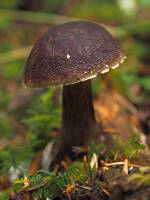
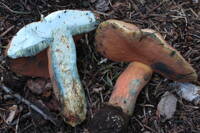
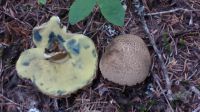
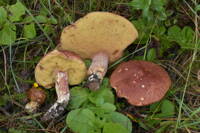
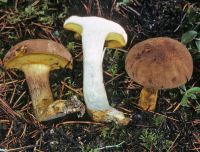
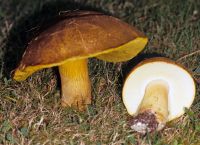
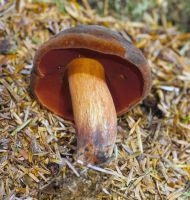
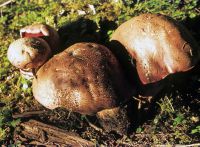
Boletus
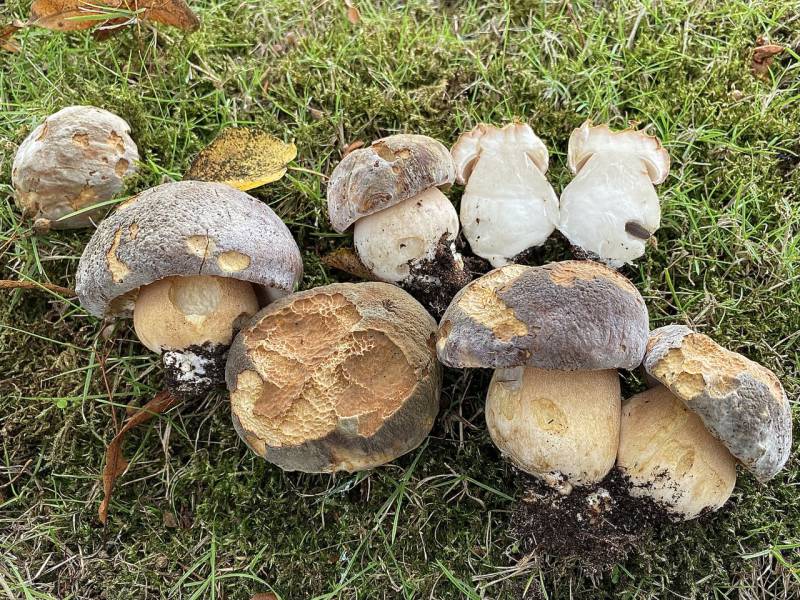
Specimens
Photos
Conservation Status: Not of concern
Description:
[none provided]
Accepted Name:
Boletus
Synonyms & Misapplications:
(none provided)
Species in Boletus:
-
Boletus abieticola

-
Boletus amygdalinus
- Boletus appendiculatus – butter bolete
-
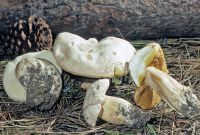
Boletus barrowsii – white king bolete Boletus barrowsii is one of the “western edulis” species (see B. edulis). It is distinguished by its overall whitish to pale tan coloration, somewhat soft suede-like texture of the cap surface, strong odor when drying, and characteristic occurrence in the mountains of the southwestern U.S., most often under ponderosa pine. Generally considered to occur only in the Southwest, there have been sporadic reports of it occurring in places such as Idaho and southern California, under trees other than ponderosa pine. In Seattle, a very similar mushroom is fairly common in late spring under oaks and species of Tilia, such as lindens and basswood. Although it was felt that this had to be a different species, preliminary DNA analysis suggests it is very close to B. barrowsii. Southwest United States
-
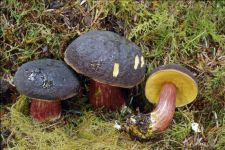
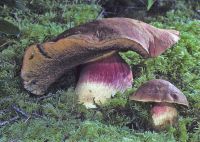
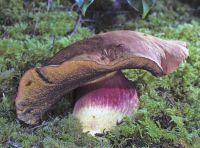
Boletus calopus – bitter beech bolete, bitter bolete Boletus calopus has bitter-flesh that differs from B. coniferarum by its more noticeable reticulate stipe that is red in part.
-
Boletus coccyginus
-
Boletus coniferarum – conifer boletus
-
Boletus eastwoodiae – Alice Eastwood's boletus
-
Boletus edulis – king bolete, penny bun, cep, porcini, steinpilz
-
Boletus ferrugineus
-
Boletus fibrillosus Boletus fibrillosus is a handsome bolete that often is mistaken for B. edulis. The cap color is some shade of dark brown, often with lighter areas, the cap surface is typically wrinkled and velvety to distinctly fibrillose, the tubes and pores are light yellow or somewhat darker, and the stipe is strongly reticulate, pale at the apex, dark brown below, and covered by white mycelium at the base. The overall aspect is that of a moderate to large cap on a relatively long stipe that often is pinched off at the base. It occurs locally, seldom as more than one or a few fruitbodies, but is widespread in our region in old-growth forests of fir and western hemlock as well as earlier succession forests of western hemlock and Douglas-fir and other mixed forest stands. Widespread in the PNW
-
Boletus haematinus
-
Boletus pulcherrimus – red-pored bolete
-
Boletus rainisii Boletus rainisii is a medium-sized species with an olive-brown to yellow-brown, velvety cap, yellow tubes, and yellow stipe with some reddish tones near the base. It stains blue to olive-green or greenish black instantly when cut or handled, and has a mild taste. It occurs in coastal conifer forests but seems to be rare.
-
Boletus regineus – queen bolete Boletus regineus is the darkest species, with almost black caps at times, and often a whitish bloom over the surface when young. It is associated with oaks and madrone.
- Boletus regius – red-capped butter bolete
-
Boletus rex-veris – spring king bolete, spring king
-
Boletus rubellus – ruby bolete
-
Boletus rubripes – bitter bolete, red-stemmed bitter bolete Widespread but not particularly common in the PNW region.
-
Boletus smithii – Smith's Boletus
-
Boletus subglabripes
-
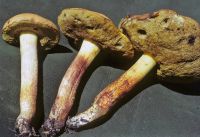
Boletus subtomentosus – boring brown bolete, suede bolete, yellow-cracked bolete Boletus subtomentosus is a large olive-brown to yellow-brown or brown species. It bruises blueish or blueish green, although not always strongly.
- Boletus truncatus Boletus truncatus is a common species in conifer forests and can only be separated from B. chrysenteron by looking at the spores, which are truncate on one end.
-
Boletus zelleri – Zeller's bolete Common in coastal and low elevation conifer forests.
Additional Resources:
PNW Herbaria: Specimen records of Boletus in the Consortium of Pacific Northwest Herbaria database
CalPhotos: Boletus photos
80 photographs:
Group by